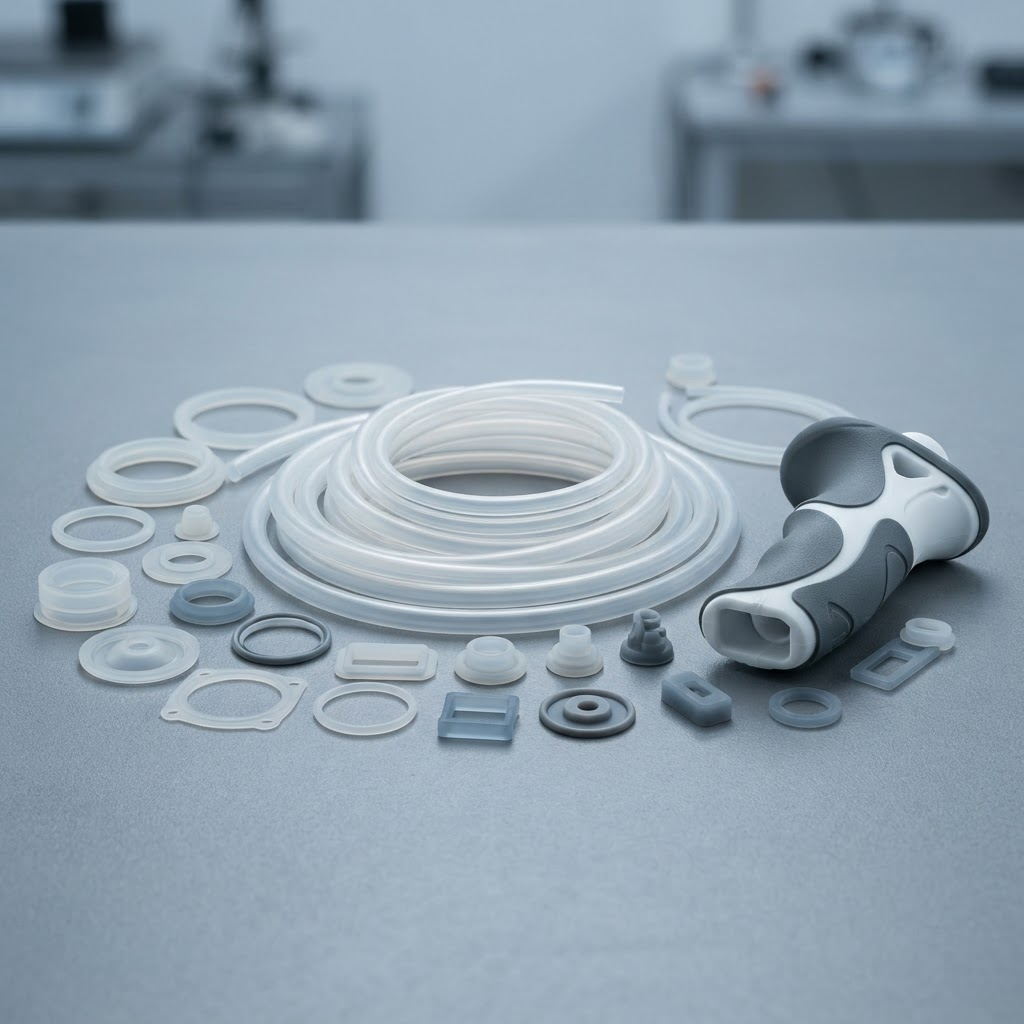
Life-Science Consumables
Labware Consumable
Labware consumables are produced in enormous volumes, so cost and moldability sit alongside clarity and chemical resistance. Different items in a family favor different resins — clear-walled tubes want clarity, while centrifuge and solvent-exposed parts want toughness and chemical resistance.
Sterilization: GammaE-BeamEthylene Oxide
Component material package
A recommended grade per component, drawn from the Nexeo catalog. Recommendations are engineering assessments; a cited property links the choice to data we hold for that grade.
| Component | Recommended grade | Why |
|---|---|---|
Clear tube / vial Transparent sample container | Eastman Tritan MX711 Copolyester (Copolyester) | A clear copolyester gives glass-like clarity with better break resistance and broad chemical resistance versus PS. |
Centrifuge / high-g part Toughened spin-down component | Purell RP374R Polypropylene (PP) | A random-copolymer PP tolerates high-g spin loads and solvent exposure at consumable cost. |
Reagent reservoir Chemically resistant bulk reservoir | Purell HP570M Polypropylene (PP) | A homopolymer-type PP gives stiffness and chemical resistance for reservoirs and troughs. |
Producer datasheetNexeo Applications Engineering assessmentAwaiting datasheetNot published by producer
Key regulatory requirements
- Certificate of analysis / lot traceability for assay use
- RNase/DNase-free and low-extractables claims validated per intended use
- ISO 11137 if terminally sterilized
Engineering watch-outs
- Clarity vs chemical resistance pulls in opposite directions — split the family across resins rather than forcing one.
- PP is not optically clear; do not use it where visual reads are required.
- Low-extractables/RNase-free status is a process+additive claim, not inherent to the base resin.
Adapt this package to your part
Hand this material package to the AI material advisor and adjust it for your process, contact duration, and material restrictions.
Open in the material advisor